
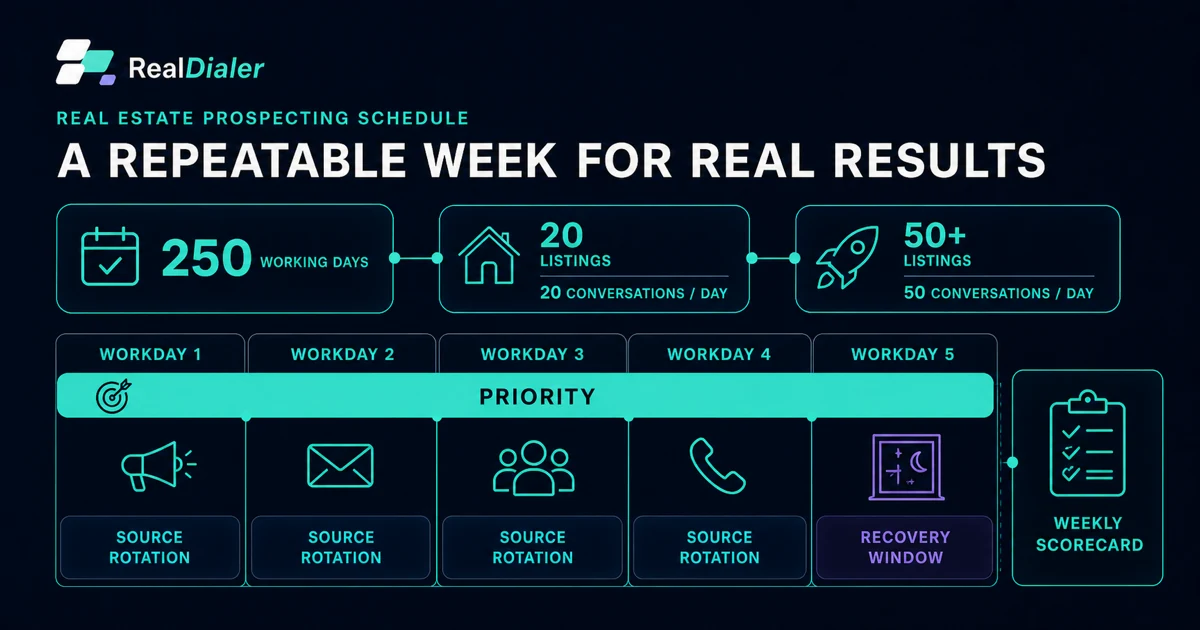
A real estate prospecting schedule is a weekly operating plan for starting new conversations, completing promised follow-up, and reviewing what moved toward an appointment. The schedule should protect calling time, keep list preparation outside the live block, give urgent opportunities priority, rotate the remaining lead sources with a purpose, and include a rule for replacing any block that gets interrupted.
The goal is not to draw a perfect calendar. Real estate will ruin a perfect calendar by Tuesday afternoon. The goal is to build a week that still works after a showing moves, an inspection goes sideways, or a seller asks to meet during the time you planned to call.
The schedule I recommend has two prospecting lanes:
- Priority lane: callbacks you promised, new inquiries, and fresh seller signals that should not wait for a themed day.
- Rotation lane: the larger audience you selected for that block, such as expired listings, FSBOs, a neighborhood around a market event, landlords, sphere contacts, or older leads.
That one distinction fixes a common scheduling mistake. A Friday follow-up theme should never make a Tuesday callback wait three days. A Wednesday circle-prospecting block should not make a fresh expired listing wait until next Monday.
Brandon Mulrenin's Daily 30 routine likewise separates 20 new prospect conversations from 10 follow-up conversations. That supports two distinct lanes; it does not turn Jon's daily listing target into a dial count.
Set the conversation target before choosing the clock time
A prospecting schedule should begin with the annual listing goal, not somebody else's favorite morning routine. I plan around exactly 250 working days per year and use this operating floor:
| Annual listing goal | Working days | Conversations per day | Five-workday example | Annual target |
|---|---|---|---|---|
| 20 listings | 250 | 20 | 100 | 5,000 |
| At least 50 listings | 250 | 50 | 250 | 12,500 |
Those numbers are planning standards, not a promise that a conversation automatically becomes a listing. The agent still has to create useful two-way exchanges, follow up, hold appointments, win the business, and serve the client. A voicemail, unanswered call, text sent, or immediate hangup is not a meaningful conversation.
The number belongs to each working day. The weekday pattern does not. Arrange the 250 days around the market, family, appointments, and planned time off. A five-day week across 50 weeks is easy to picture, so I use one below, but Monday through Friday is only a sample. Monday through Saturday is not a rule either.
Use the daily real estate prospecting calculator to translate the conversation goal into the unique people and raw attempts your actual sources require. Keep those measurements separate. A 50-conversation goal never means 50 dials.
A repeatable weekly real estate prospecting schedule
This is a five-workday example for an agent who chose that cadence. Change the days and clock times to fit your annual plan, market, family, and appointment load. Keep the order and the job of each block clear.
| Day | Before the call block | Priority lane | Rotation lane | Closeout | Weekly job |
|---|---|---|---|---|---|
| Monday | Review last week's open promises and confirm list inventory | Due callbacks and fresh opportunities | Expired, canceled, and older seller leads | Save next actions and clear unresolved outcomes | Set the week's source assignments and protected blocks |
| Tuesday | Open the prepared list and check the session purpose | Due callbacks and new responses | FSBO and landlord conversations | Confirm appointments and prepare Wednesday's list | Create new seller conversations |
| Wednesday | Check overdue follow-up before starting new outreach | Due callbacks and fresh opportunities | Circle prospecting around one real market event | Save outcomes and correct list problems | Run a short midweek pipeline check |
| Thursday | Open the source with the strongest unfinished opportunity | Due callbacks and new responses | A second focused seller list or old-lead reactivation | Confirm next actions and prepare Friday's list | Finish the week's main new-business work |
| Friday | Review every promise due before the weekend | Due callbacks and appointment confirmations | Follow-up sweep, sphere calls, or a focused neighborhood block | Close open loops and stage Monday | Read the scorecard and replace any missed block |
The exact source rotation is less important than the separation. Each block needs one dominant audience, one reason for calling, and one definition of success. Mixing unrelated lists can make the conversations and report less useful.
Download the two-page RealDialer Weekly Prospecting Schedule Board. Page one is blank; page two shows Morgan's completed fictional week and recovery window.
For the broader strategy behind audiences, pipeline math, outcomes, and review, use the complete real estate prospecting system. The Real Estate Prospecting hub connects this schedule to the main seller-prospecting methods.
Build the schedule around work that cannot be improvised
Put fixed commitments on the calendar first: closings, inspections, listing appointments, buyer consultations, school pickup, days off, and any recurring team responsibilities. Then place prospecting where it can happen consistently without competing with predictable obligations.
Do not begin by filling every open hour. Begin with the work the pipeline cannot survive without:
- new outbound conversations;
- due follow-up and callbacks;
- appointment setting and preparation;
- list building and quality checks;
- daily outcome cleanup;
- weekly reporting and planning.
Give routine messages and transaction updates defined communication windows. Otherwise, non-urgent work can consume the first part of every call block.
Decide the block by output, not by calendar decoration
A scheduled block is not successful because it remained blue on your calendar. It is successful when you were ready at the start, worked the intended list, handled live conversations well, recorded every outcome, and completed the next actions that were due.
Use four questions when placing a block:
- Which people belong in it?
- Why might this audience talk with me now?
- What must be ready before the start time?
- What evidence will show that the block was completed?
If the answer to the first question is "whoever is in the CRM," the block is not ready.
Keep list preparation out of calling time
Agents often schedule 90 minutes for prospecting and spend the first 25 minutes finding a file, removing obvious duplicates, reading property records, and deciding what to say. That was a preparation block wearing a prospecting label.
Prepare tomorrow's primary list during a short closeout window today. Before the next session begins, confirm:
- the list has a name, source, market, and purpose;
- the property and contact fields needed for the conversation are present;
- duplicate numbers and obvious data problems have been resolved;
- the campaign has passed the brokerage's eligibility and compliance process;
- the reason for the call and the useful offer are clear;
- the correct agent phone, caller identity, audio, and return path are ready;
- the outcomes and follow-up path are understood.
The real estate dialer setup checklist covers that preflight. Calling rules and lawful hours can depend on the list, number, called person's location, relationship, consent, technology, message, and state law. Use the RealDialer compliance guide as an operating starting point and get qualified guidance for the campaign itself.
Use a call-block structure that protects conversations
Here is a practical two-hour block for an agent whose list is already prepared. It is an operating example, not a claim that every agent can reach 20 or 50 conversations in two hours. Use your measured conversations per hour to reserve enough blocks for the daily target. Adjust the clock times, but do not let preparation consume the conversation window.
| Time | Job | Finished when |
|---|---|---|
| 8:30-8:40 | Preflight | Correct list and session are open; audio, caller identity, and priority callbacks are confirmed |
| 8:40-9:00 | Priority lane | Due promises and time-sensitive opportunities have an outcome or a dated next action |
| 9:00-10:10 | Rotation lane | The designated audience has been worked without unrelated admin or list switching |
| 10:10-10:25 | Lead closeout | Appointments, callbacks, and useful notes are complete |
| 10:25-10:30 | Tomorrow setup | The next list owner and any required correction are identified |
Outcomes should be saved as the calls happen. The closeout is not an invitation to reconstruct 90 minutes from memory. It is for the handful of conversations that need an appointment confirmation, a longer note, a market analysis, or another promised action.
A real estate cold-calling script should match the source. An expired owner, a FSBO, and a homeowner near a new listing did not arrive in the database for the same reason. Their scheduled blocks should not use the same generic opening.
Schedule lead sources by signal and purpose
A source earns calendar space because it supplies a specific kind of opportunity, not because another agent said it was good.
| Source | Signal | Best job in the week | What not to assume |
|---|---|---|---|
| Expired or canceled listing | A recent attempt to sell ended | Diagnose what happened and whether the owner still wants a result | The owner wants another agent immediately |
| FSBO | The owner is actively testing a self-sale plan | Learn the owner's plan, friction, and backup decision | The owner has failed or needs to be corrected |
| Circle around a listing, pending sale, or closing | A specific local market event occurred | Create relevant neighborhood conversations | Proximity proves an intention to move |
| Landlord or FRBO | The owner is making a rental or portfolio decision | Discuss vacancy, management burden, value, or portfolio plans when relevant | Every landlord is tired or ready to sell |
| Older lead | A prior conversation or inquiry exists | Reopen the decision using the previous context | The old note is still accurate |
| Sphere or past client | A real relationship already exists | Stay useful, ask about plans, and create referral conversations | Familiarity removes the need for a reason to call |
The priority lane can pull a record from any source when a real deadline or promise exists. The rotation lane protects the larger audience from being ignored while the agent handles only the hottest names.
Use the dedicated guides for expired listing prospecting, FSBO prospecting, and circle prospecting when you assign those sources to the week.
Create recovery rules before the calendar breaks
A repeatable schedule is defined by what happens after an interruption. "I will try again tomorrow" is not a recovery rule. It is a wish.
| What happened | Decision during the block | Calendar action |
|---|---|---|
| Routine text, email, or vendor question | Leave it for the next communication window | No change |
| A prospect asks for an appointment | Book it, save the outcome, and resume the block | Add preparation time outside the live session |
| A real client emergency requires action | Finish the current conversation safely and pause | Move the remaining block to the named flex window |
| A listing appointment takes the planned time | Protect the appointment | Replace the block elsewhere in the same week before accepting optional work |
| The list has a serious eligibility or data problem | Stop the session | Quarantine the list and use an already-approved backup source |
| The block is missed without an emergency | Record it honestly | Use the named replacement window; do not pretend unscheduled activity made it up |
Reserve one flex window before the week begins. It can be a late-morning block, a specific afternoon, or Friday morning. The point is to decide where displaced prospecting goes while the calendar is calm.
Do not double the next day's block as punishment. Long recovery marathons can damage conversation quality and make the schedule harder to repeat. Replace the missed block with a real start and stop time, then return to the normal week.
A completed week: useful even when Tuesday goes wrong
Consider Morgan, a fictional listing agent with a 20-listing goal. Morgan planned 250 working days and 20 meaningful conversations per day, or 100 across this five-workday sample. Morgan has five morning blocks, one Tuesday afternoon flex window, and a Friday review. Lists are staged at the end of the prior workday.
| Day | What was planned | What actually happened | Recorded result |
|---|---|---|---|
| Monday | Priority callbacks plus expired and canceled listings | Completed as scheduled | 20 conversations, 3 callbacks, 1 lead |
| Tuesday | Priority callbacks plus FSBO and landlord calls | Inspection problem stopped the morning block; remainder moved to the 2:00 PM flex window | 7 morning plus 13 flex-window conversations, 2 leads, 1 appointment |
| Wednesday | Priority lane plus circle calls around a recent closing | Completed; one bad-data pattern found and flagged | 20 conversations, 3 callbacks |
| Thursday | Priority lane plus old seller-lead reactivation | Completed; seller requested a next-week pricing review | 21 conversations, 1 lead, 1 appointment |
| Friday | Promise sweep plus focused circle calls | Completed; every promised callback had a next date | 19 conversations, 1 lead; weekly total reached 100 |
The conversion results are fictional, but the conversation count follows the 20-for-20 operating floor. The useful part is that Tuesday did not disappear. Morgan paused the session, moved the remaining work to a preselected flex window, and combined the results under the same source and purpose for review.
The schedule also produced evidence. Morgan can see which lists created conversations and which conversations became leads or appointments. Unique people and raw attempts remain separate fields in the report; they were not substituted for conversations. Without saved outcomes, the week would only prove that time was spent near a phone.
Review the week with a scorecard that can change a decision
Start with 15 to 25 minutes for the weekly review. This is not a meeting with yourself about motivation. It compares the week you scheduled with the week you ran.
Track:
- prospecting blocks scheduled, completed, replaced, and missed;
- raw call attempts and unique contacts attempted;
- unique contacts answered and conversations;
- leads, callbacks, appointments, and listings created;
- dial time and talk time;
- results by named list or lead source;
- promised actions still open before the next week.
Raw attempts and unique people are different. One person may receive more than one attempt, so a high attempt count should not be reported as that many homeowners prospected. Compare sources using consistent definitions.
Then ask five operating questions:
- Did the blocks start with a ready list?
- Which source produced actual conversations?
- Which conversations created a lead, callback, or appointment?
- Were outcomes and next actions saved before the week ended?
- What one calendar or preparation change belongs in next week?
Do not rebuild the entire system every Friday. Make the smallest change that corrects the clearest failure. If the same list problem appears twice, fix the source process. If a block is interrupted at the same time every week, move the block or the recurring obligation. If conversations are happening but appointments are not, review the conversation before buying more data.
How RealDialer turns the calendar into an operating system
A calendar can reserve the time. It cannot run the work inside the block.
In RealDialer, the agent can prepare a named list and session for one source, verify the calling path, and begin with relevant contact and property context available. Multi-line dialing processes unanswered ringing, voicemail, busy signals, and failed attempts in parallel so more live conversations can fit inside a fixed prospecting block. The purpose is not a line-count contest. It is to spend more of the session speaking with people.
When someone answers, RealDialer brings contact context, notes, history, and outcome controls into the live workflow. The agent records what happened and schedules follow-up when a promise is made. A saved do-not-call outcome suppresses future calls inside the workspace; that status does not independently clear any other record or campaign for calling.
After the block, reporting separates raw attempts from unique contacts attempted, answered contacts, conversations, leads, appointments, and listings. Dial time, talk time, personal timing, and list-level results show whether the scheduled work was prepared and productive.
That closes the gap between "prospecting from 8:30 to 10:30" and a session you can inspect, coach, and repeat. Explore the RealDialer real estate dialer when you are ready to build the next call block around a named list, complete outcomes, dated follow-up, and a report you can use.
Frequently asked questions
What is the best real estate prospecting schedule?
The best schedule protects recurring new-business blocks, gives due callbacks and fresh opportunities priority, keeps list preparation outside live calling time, saves outcomes during the session, and includes a replacement window for interruptions. The clock time should fit the agent's market and obligations. The operating sequence matters more than copying another agent's calendar.
Should follow-up and new prospecting be in the same block?
They can share a larger prospecting window, but they need separate lanes. Complete time-sensitive promises first, then protect the main portion for the designated new-outreach list. If follow-up is allowed to consume the entire block every day, the agent eventually stops creating new people to follow up with.
How many hours a day should a real estate agent prospect?
Start with the result, then size the block. For a 20-listing goal, plan 20 meaningful conversations on each of 250 working days. For at least 50 listings, plan 50 per working day. Divide that daily target by your measured conversations per hour for the source to estimate the time required. There is no universal hour count because answer rates, list quality, and conversation length vary. A protected session with a ready list is more useful than a larger block consumed by preparation and interruptions.
What should happen if a prospecting block is missed?
Move it to a flex window that was reserved before the week began. Give the replacement a real start time, stop time, source, and purpose. Do not erase it silently, and do not turn the next day into a punishment session that makes the rest of the week harder to repeat.
What should be prepared the day before?
Prepare the named source list, required contact and property fields, campaign eligibility checks, conversation reason, useful offer, caller identity, outcome choices, and any priority callbacks. The next session should start with a call, not a search for something to call.
Which metrics belong in the Friday review?
Review scheduled versus completed blocks, unique contacts attempted, answered contacts, conversations, leads, callbacks, appointments, listings, dial time, talk time, and results by list. Also inspect every open promise. A schedule that creates conversations but loses the next action is not complete.