
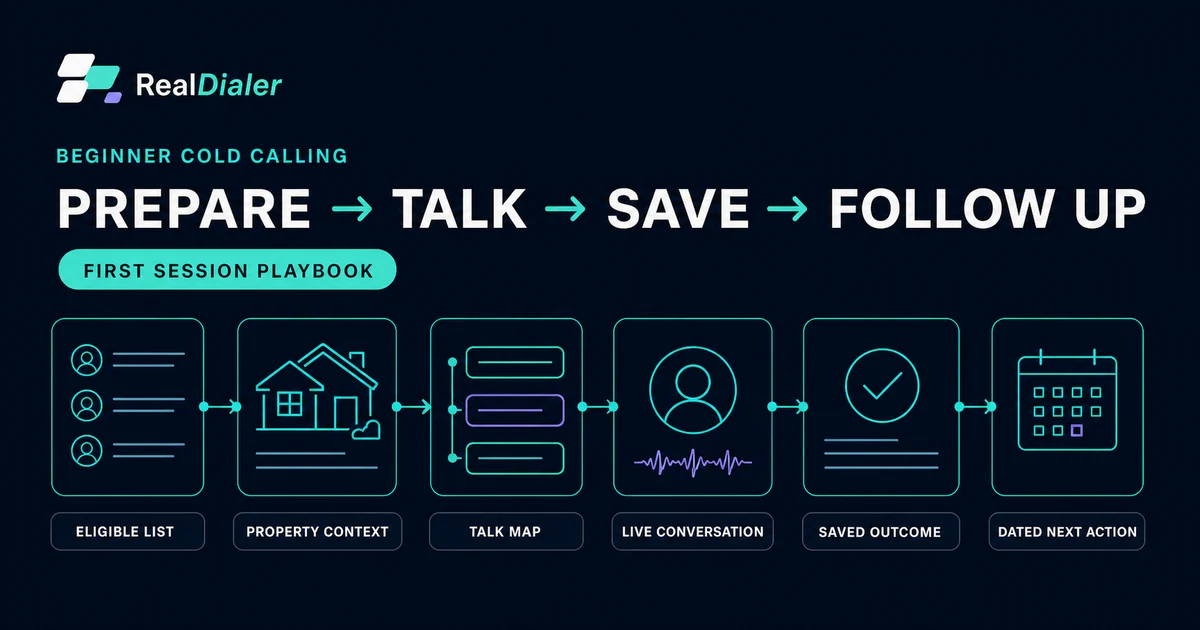
In everyday real estate practice, cold calling means unsolicited outbound prospecting to someone who did not request the call and typically has no active relationship with the agent. It is an operating label, not a legal category or exemption. A beginner should work one eligible audience, give an honest reason, listen for a property need, save the outcome, and complete every promise.
Most beginner guides start with scripts, skipping the work that gives any opening a chance: choosing eligible owners, understanding the property, knowing why the call matters, and deciding what follows a useful conversation.
The beginner's operating path is:
Eligible list -> relevant reason -> prepared context -> live conversation -> honest outcome -> dated next action -> review
If one part is missing, the block leaks. A good opener cannot repair an ineligible list, and a useful conversation is wasted when the callback lives on a sticky note. Mixed, unnamed lists make a high dial count hard to interpret.
What a real estate cold call is supposed to accomplish
The call has three jobs:
- Explain who you are and why you called this person.
- Learn whether a real property conversation exists.
- Agree on the next action, or close the contact respectfully.
The next action might be a listing review, market comparison, scheduled callback, buyer conversation, or no further contact. An appointment is not required for the call to be handled well.
Cold calling is one part of a real estate prospecting system. The complete real estate prospecting operating guide connects calls to pipeline goals, source selection, protected contact blocks, follow-up, and review.
Before you dial: confirm the campaign can be run
Cold calling is regulated. The rules can depend on the number, person, list source, prior relationship, consent, calling technology, message, location, time, brokerage, and whether another state is involved. Do not copy an exemption from an article and assume it covers your campaign.
Before a beginner calls a list, the broker, campaign owner, or qualified counsel should answer these questions:
- Where did the phone data come from, and is its use permitted?
- Was the list checked against the National Do Not Call Registry and applicable state lists using the required process?
- Does the brokerage maintain an internal do-not-call list and written procedures?
- What calling days and times apply to the states involved?
- What caller identity and return number must be transmitted?
- Are manual, multi-line, prerecorded, artificial-voice, text, and recorded-call rules different for this campaign?
- How will opt-outs, do-not-call requests, reassigned numbers, and complaints be handled?
- What records must be retained, by whom, and for how long?
The FTC's current Telemarketing Sales Rule guidance says covered callers must maintain procedures for honoring do-not-call requests and use a National Registry version downloaded no more than 31 days before calling. The FTC also warns that state and FCC requirements may apply.
Review 47 CFR 64.1200 and NAR's cold-calling guidance with qualified counsel. NAR specifically warns that advertising a FSBO or having a listing expire does not by itself permit a solicitation call to a number on the National Do Not Call Registry. The answer belongs in a documented process, not in an agent's memory.
Use the RealDialer compliance guide as an operating starting point. It is not legal advice for a specific list or campaign.
Choose one beginner cold-calling audience
A cold list is not simply a collection of phone numbers. It is a group of owners connected by one reason for a possible conversation.
| Audience | Why the call may matter | Beginner advantage | Beginner risk |
|---|---|---|---|
| Circle around a recent listing or sale | Something changed in the neighborhood | Clear local reason and easy property research | The event does not prove the owner wants to move |
| Expired listings | The owner's first sale plan ended without a sale | Visible and recent seller intent | Competition, frustration, and a need for real diagnosis |
| FSBO | The owner is actively testing a self-sale plan | The property and sale decision are public | Arguing for a listing too early destroys trust |
| Landlords or FRBO | The owner is making a rental or portfolio decision | Specific property-owner context | A vacancy does not mean the owner wants to sell |
| Dormant leads (reactivation) | A prior property conversation can be reopened | Prior context when notes are reliable | This may be warm follow-up rather than cold outreach; stale data still needs a fresh eligibility review |
Circle prospecting is often easier to understand because a market event supplies the reason for the call. Expireds and FSBOs offer stronger seller signals, but the agent needs better research and a more useful offer.
Do not begin with a file labeled "homeowners." Choose a source you can name and explain. See the RealDialer guides to circle prospecting, expired listing prospecting, and FSBO prospecting for audience-specific conversations.
Prepare five pieces of context for every call
The agent should be able to see:
- the person's name and property address;
- the list source and event that created the record;
- one or two facts relevant to the property or neighborhood;
- the reason for calling now;
- the useful next action the agent can actually deliver.
For a circle list, that could be the nearby address, sale date, price, days on market, and how the property compares. For an expired, review pricing history, presentation, competition, and what changed after the listing ended.
Do not spend 20 minutes researching every homeowner before anyone answers. Prepare only the fields needed for an accurate, relevant live conversation; deeper work follows a stated need.
The Real Estate Dialer Setup Checklist covers the path from source file and field mapping through caller identity, audio, controlled calls, outcomes, and reporting.
Use a six-part talk map, not a monologue
Write prompts for the conversation, not a speech to perform. The examples below are set in early September.
| Part | Question it answers | Circle-prospecting example |
|---|---|---|
| Identity | Who is calling? | "This is Alex Carter with Pine Street Realty." |
| Reason | Why this person, and why now? | "The home at 214 Birch closed Friday, and I am calling nearby owners." |
| Opening question | Is there a conversation here? | "Did that sale change how you are thinking about your property?" |
| Discovery | What matters to the homeowner? | "Are you planning to stay for a while, or is a move somewhere on the horizon?" |
| Useful offer | What can the agent provide? | "I can send a short comparison showing how that sale relates to your home." |
| Next action | What happens, by whom, and when? | "I will send it today and call the first week of November if that works for you." |
Match the opening to the list: ask an expired owner what they decided after the listing ended, a FSBO how the sale plan is working, or a landlord whether they are filling the vacancy, changing management, or reviewing other property options.
Use the real estate cold-calling scripts as source-specific frameworks. Read the opening out loud until you understand it, then speak like yourself.
Practice before a homeowner becomes the rehearsal
Role-play with another person who will interrupt, question the premise, give short answers, and ask how you found the number. Practice the transition from opening to discovery and from discovery to a reasonable next step.
Record a practice call only when every participant consents and applicable law and brokerage policy permit it. Listen for:
- an introduction the other person can understand;
- a clear reason for the call in the opening seconds;
- rushed words, filler, or a fake cheerful voice;
- questions that sound like an interrogation;
- talking over the answer;
- an appointment request that does not match what the owner said;
- a vague close such as "I will follow up sometime."
The goal of practice is not to remove every pause. It is to make room for the homeowner's actual answer.
A complete beginner cold-call example
The following fictional call continues that circle-prospecting example. The list passed the campaign's eligibility process, and Alex did not handle the nearby sale.
Alex: Hi, Maria. This is Alex Carter with Pine Street Realty. I am calling because the home at 214 Birch, around the corner from you, closed on Friday. I work in this part of Franklin, and I wanted to ask whether that sale changed how you are thinking about your property.
Maria: Not really. We are not selling right now.
Alex: Understood. Are you planning to stay for the next few years, or is it just not something you are considering today?
Maria: Maybe next spring. My daughter finishes school this year, so we have not decided.
Alex: That makes sense. You do not need a listing pitch today. Would a short comparison of the Birch sale and the current range around your home be useful, or would you rather I leave it alone?
Maria: You can email it.
Alex: Happy to. What is the best email? I can send it this afternoon. Would it be all right if I call during the first week of November after you have had more time to think about spring?
Maria: That is fine.
Alex: Great. I have the email and the first week of November. Thank you, Maria.
The result is not an immediate appointment. It is a real timeline, permission to send a comparison, and a callback in November. Alex must deliver both.
Save it as a conversation with a scheduled callback. Notes should capture the possible spring move, school timing, promised comparison, email, callback week, and that the nearby sale was not Alex's transaction.
Handle common responses without wrestling the homeowner
| Homeowner response | Useful reply | Required action |
|---|---|---|
| "I am not interested." | "Understood. Thank you for telling me." | Record the outcome accurately |
| "How did you get my number?" | Explain the actual list and data source plainly | Do not hide or invent an answer |
| "I already have an agent." | "Good. I will not interfere with that relationship." | Close the call and record it |
| "This is a bad time." | "I understand. Would you like a call at another time, or should I leave it here?" | Date the callback only with agreement |
| "We are never selling." | "Understood. I appreciate the clear answer." | Close respectfully instead of forcing a referral question |
| "Take me off your list." | "I will record that now." | Save do not call immediately and do not rebut it |
An objection may be a question, a condition, or the end of the call. Learn the difference.
Save the outcome before making the next connected call
Use a small, stable set of outcomes:
- no answer;
- busy;
- voicemail;
- bad number;
- conversation;
- not interested;
- callback scheduled;
- lead created;
- appointment set;
- do not call.
Notes preserve what was learned; outcomes drive what happens next. Replace "nice person, maybe later" with why, when, the promised action, and its owner.
Save a do-not-call request before continuing; never bury it in notes. For a callback, capture the agreed date or window, reason, and owner. For an appointment, confirm its purpose and preparation.
Run the first cold-calling session as a controlled operation
Before the session
- Select one eligible, named list.
- Confirm caller identity, return path, audio, and local time.
- Put the talk map and useful offer on screen.
- Open the property context and outcome choices.
- Define the conversation target and session stop time.
- Stage a separately prepared backup list if the primary list runs out.
During the session
- Read the next person's name and property before the attempt.
- On a live answer, state the identity and relevant reason clearly.
- Ask one opening question, then listen.
- Follow what the owner says instead of racing to the next script line.
- Agree on a useful next action only when the conversation earns it.
- Save the outcome and notes before moving forward.
After the session
- Complete or schedule every promise.
- Confirm callbacks and appointments have dates and owners.
- Review do-not-call requests and bad data.
- Record one observation about the list, opening, or workflow.
- Leave the next comparable list ready for review.
A completed beginner session scorecard
This fictional block used the same circle audience and talk map throughout.
| Field | Result |
|---|---|
| Eligible unique people prepared | 72 |
| Unique people attempted | 49 |
| Raw call attempts | 61 |
| Live answers | 8 |
| Meaningful conversations | 5 |
| Callbacks scheduled | 2 |
| Leads created | 1 |
| Appointments set | 0 |
| Bad numbers | 2 |
| Do-not-call requests | 1 |
| Promises completed or dated | 3 of 3 |
These are examples, not industry benchmarks. The useful result is five documented conversations, three owned promises, and no lost do-not-call request, not 61 raw attempts.
Diagnose the first problem, not the entire career
| What happened | Inspect first |
|---|---|
| The session started late | List preparation and calendar protection |
| Few people answered | Data quality, source age, calling window, and caller identity |
| People answered but ended the call immediately | Relevance, opening, pace, and clarity |
| Conversations felt like interviews | Question sequence and whether the agent reacted to answers |
| Good conversations created no next step | Discovery, useful offer, and clarity about timing |
| Callbacks were forgotten | Outcome capture, ownership, and reminders |
| The agent froze after a harsh response | Role-play, reset routine, and talk-map familiarity |
One difficult session proves little and is not a reason to enlarge the list. Repair the first broken stage, then compare the next session using the same source and outcome definitions.
How RealDialer supports a beginner's calling workflow
RealDialer keeps the calling block attached to a named list and session. When a homeowner answers, the agent sees the contact, property context, history, notes, and outcome controls together. The current result is saved before the workflow advances to the next connected call.
The multi-line workflow processes unanswered ringing, busy signals, voicemail, and failed attempts in parallel so more of a fixed block can be spent in live conversations. That is its purpose. It does not make the talk map, judgment, or listening less important.
List reporting separates raw attempts from unique people attempted, answers, conversations, leads, appointments, listings, untouched contacts, and contacts remaining without a saved conversation outcome. Callback timing is scheduled in the workflow, while the reason and context belong in the notes. A saved do-not-call outcome suppresses later calling to that contact in the workspace, but a workspace status is not independent legal clearance for a campaign. Qualified leads can move into CloseDaily when the longer follow-up relationship begins.
How a Real Estate Dialer Works Behind the Screen explains the technical path from list record through the live workspace, outcome, and report. Explore the RealDialer calling workspace when you are ready to build your first complete calling block.
Frequently asked questions
Is cold calling in real estate legal?
It is regulated, and legality depends on the list, consent, relationship, technology, state, time, identity, and other campaign facts. Confirm current requirements with the broker and qualified counsel.
What is the best cold-calling script for a new real estate agent?
Use a framework that identifies the agent, gives a truthful reason, asks one relevant question, listens, offers something useful, and defines the next action. Adjust it for the list.
How many cold calls should a beginner make each day?
Set a meaningful-conversation target, then use that list's unique-person conversation rate to estimate the eligible people required. Universal quotas ignore source, data, schedule, and skill.
Should a beginner leave voicemail on every unanswered call?
Follow the approved policy. If voicemail is permitted, identify the caller as required, give the approved return path, keep the message accurate, and track it separately.
Build a call you can finish
Choose one eligible audience, prepare the property context and talk map, listen, save the outcome, and keep every promise. The words matter, but the surrounding system turns early conversations into a reliable database and future business.